Sunday, July 24, 2011

Keyboard Shortcuts

I believe the more efficiently we use our keyboard, the more time we can save while using our computers.

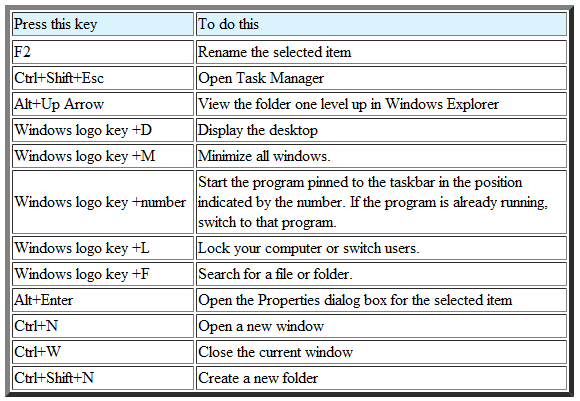
Most of us use the basic keyboard shortcuts such as for cut, copy, paste, undo, redo etc. Windows 7 supports hundreds more. Many of them are not commonly-known. In this post, I'm sharing some of them that I have been using almost daily and think are good mouse-click-savers.


Hope you guys find some of these useful.

Reference: Windows 7 Keyboard Shortcuts

Thursday, December 30, 2010

Book review: "So What?: How to Communicate What Really Matters to Your Audience"

Yesterday, I finished reading - So What?: How to Communicate What Really Matters to Your Audience written by Mark Magnacca. I liked the book so thought would write a few words about it and hence this post.

The book is organized in about 125 pages containing 10 chapters all of which essentially convey one single central message i.e. to communicate effectively by answering the "So What" question. Mark has used a simple tone and has clearly illustrated with several examples that effective communication is a must have tool which, can make you a better marketer, presenter and orator. Every chapter of the book begins with a unique quote which tells us the theme for that chapter. My favorite quote from the book comes at the beginning of the 8th chapter :

"The difference between the right word and almost the right word is the difference between lightning and a lightning bug." -- Mark Twain

I also enjoyed reading the examples of how Coca-Cola came to market domination and how President John F. Kennedy announced his desire to land a man on the moon. My favorite phrase from the book is the title of chapter 7 : "winging it versus orchestration". I firmly believe that good preparation is absolutely necessary to make a solid presentation or speech.

In summary, the book teaches how to be a better communicator by always keeping the audience in the mind. If you want to be a better sales-person, presentation-maker or public-speaker, this book is definitely worth a read.

Saturday, April 24, 2010

Ain't reading good?

I love reading a lot these days. Here is a list of books I ordered for reading this summer -


Hope to publish my reviews for some of these soon.

Sunday, April 4, 2010

My Own 3G Network

Since I am not very pleased with AT&Ts often unreliable 3G network, I decided to start my own. Here is a preview -


Let me know if you are interested in subscribing. :)

Saturday, March 27, 2010

Mumbai Airports

5 things I liked:
1. Nice new infrastructure.
2. Good use of sign boards to guide us to different parts of the airport.
3. Free trollies and free rides between international and domestic airports.
4. Fast immigration checks and customs   services.
5. Presence of lounges and vending machines.

10 things I disliked (personal experience):
1. Rude immigration officer.
2. Ground staff demanding "Bakshis" (tip) for everything they do.
3. A security gaurd asking me what did I bring for him and expecting an answer. (My answer was a big awkward smile.)
DOMESTIC AIRPORT:
4. Unclean restrooms.
5. A stray cat running amock at the terminal.
6. A lady creating big fuss and drama after being asked for relevant documents before her boarding.
7. Expensive (by Indian standards) coffees and sandwiches.
8. A gaurd clearing his throat in front of other people and then frequently spitting into a trash can.
9. No wifi, no Internet on the terminal.
10. Too long queues before boarding.   
Thursday, July 16, 2009

My Master's Thesis Abstract

Low cost availability of sensor nodes makes them an attractive choice for sensor networks and their applications. To keep the costs low, sensor nodes are generally unshielded. This unshielded nature of sensor-network nodes combined with their ease of deployment, makes them vulnerable because an adversary can capture these nodes, copy security information to make replicas and deploy the replicas in the network to render malicious attacks. Replication attacks can be extremely hazardous to a network if done in a strategic way. For any node replication detection protocol, the three most important design issues are memory usage, detection probability and energy consumption. Previous node replication detection schemes either incur large memory overhead or consume excessive energy, particularly in the central region of the network. This thesis presents a Memory Efficient Line-Selected Multicast (MELSeM) algorithm which uses efficient bloom filter data structure. We propose a novel distributed technique for detecting node replication attacks using MELSeM. MELSeM reduces the average memory overhead of the network by nearly 70% than the previous distributed schemes while achieving nearly same detection probability.

Vishal's shared items